This is our old, outdated site. You will be redirected to our current website in a moment.

Thank you, Thatresourcesite.com

Just completed: Our Little Timeline of the Old Testament

Start learning history from the very beginning

When do you teach that history begins in your homeschool or CCD class?  In our little homeschool, we teach that history begins at the very beginning of time.  The start of everything begins with God's creative glory; God created everything out of nothing.  To help teach this awesome concept to our children, we use the Old Testament, of course.

We have had such great response to our Life of Christ Timeline both from our own children as well as online visitors that we decided to do a new timeline to go with the history of the Old Testament of the Bible. 

Our new timeline goes with the first half of the book, Child's Bible History by Rev. F.J. Knecht and covers some of the earliest historical occurrences.  You will find that the author focuses on 28 historical stories from the Bible, most of which are contained in the first few books of the Bible.  This read is suitable for grades 3-5 and so many of the events and topics are suited specifically for them. We have created our timeline to accompany this work although it can very easily be used independently of it.
Child's Bible History
This resource includes the timeline lines, the pieces for the timeline and a references sheet.  A unique feature of this timeline is that we have included the scripture references for each of the events highlighted.  Younger students may simply just put the timeline up and add the pieces in order.  Older learners may want to look up the passages for discussion.  Some events require a bit of reading - say a chapter or so, while other passages are quite short.

To use this resource simply download and print out the sheets.  (We recommend using heavier bond paper for the lines and regular paper for the actual pieces.)  As you read and discuss the individual stories from the Knecht book or the scripture suggestions on the timeline pieces, affix the timeline piece to the purple lines.  In general, there will be three pieces per line and 28 in total.  Feel free to modify as needed.  Perhaps you want to join the lines to make them six pieces wide or simply glue just the pieces into a history notebook - that is just fine too.  Flexibility is one of the most beautiful things about homeschooling.

Our smaller timelines are not overwhelming and are perfect for those of us who are short on space, live in an apartment or simply want to focus on one theme at a time.  Thinking about where you may want to put this timeline?  You may want to affix your timeline to any of a number of areas in your home:

A kitchen wall - great conversation spark for supper or tea time
The wall in your homeschooling area - great reference tool
Your child's bedroom wall or door - decorate with your faith
The inside of the bathroom door - for your captive audience
A large piece of poster board - for a more portable timeline.

Go to our Little Timeline of the Old Testament page now.
See all of our Timeline collections now.

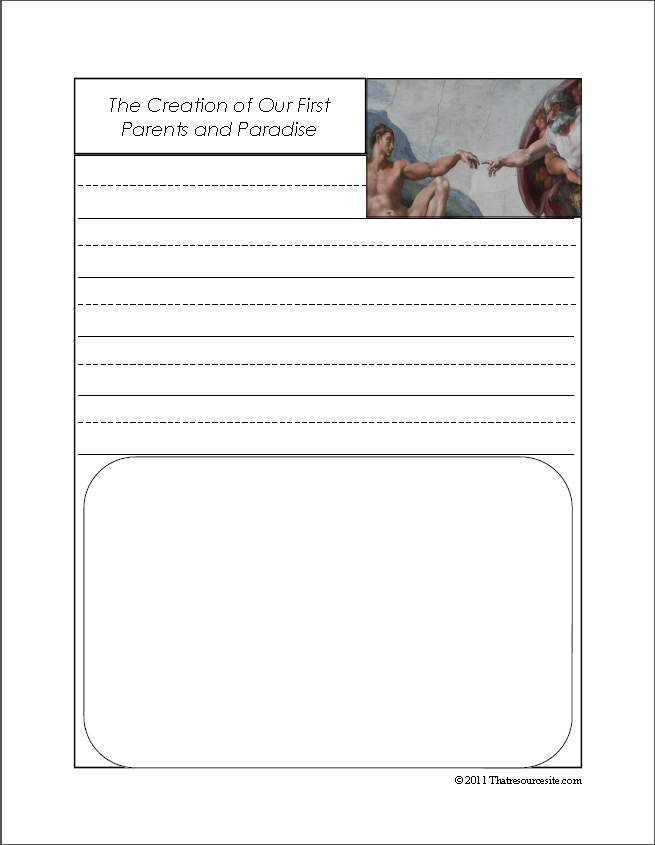
As with the other timelines, we also have accompanying notebook pages to go with each of the 28 stories.  They are in our traditional That Resource Site style of four line spacing options to meet the needs of every aged learner as well as options to draw your own picture, draw the scene, or use the picture provided.  Each set is twelve pages.


We hope that many find these resources very helpful.  We hope to offer a few more resources to accompany these Bible stories if time allows.

Blessings,
That Resource Team

Resources to Help Organize Your Learning Year

We have tried to offer some free printable planning sheets to help you organize your year.  To help even more, we thought we might offer a few more highlights on other resources you may find useful.

If you have joined us on Facebook, then you already know that we have updated our printable calendar selections for your next learning year.  If you haven't yet explored our calendar page, now might be a good time.  We have updated our at-a-glance yearly calendar, our angel themed calendar, and the bright weather themed calendar to help younger children with tracking the weather among others. If you enjoy bright colours, then our thematic calendar may be just what you are looking for with a simple layout and a background that changes monthly.  Lastly we offer a newly designed calendar which celebrates the liturgical year.  This is a great addition to your learners three ringed binder or learning log.  You can find all of these calendars and more on our predated printable calendars page.

Click HERE to visit our printable predated calendars page now. 


A quick word on our weather calendar and additional go along resources: 

If you need or want your kiddos to track the weather this coming year or even for the summer, then you may want to take a peek at our weather calendar, cut out pieces to glue on it and our weather worksheets for junior or senior learners.  Weather you are simply looking out the window, using a thermometer, or using a digital weather gauge to see God's glory in action, our printable resources can come in handy.  The picture at the right shows the calendar on the bottom with stickers glued on.  The page at the top is from our incentive page collection.

Click HERE to visit our weather resource page now.
Click HERE to see our collection of incentive pages now.


If you are looking for other organizing helps such as an assessment log to store grades or marks, vendor sheets to help with ordering and comparison shopping from curriculum catalogs or colourful attendance sheets, then perhaps we can help with those needs as well. 


Click HERE to visit our  Free Planning Sheets for Homeschoolers and Educators resource page now.


We hope these free printable organizing sheets help make your job of preparing for your next learning year easier and quicker.

Want to keep up with even more of our resource additions?  Why not join us on Facebook! 

Blessings,

Kalei - That Resource Team

Need Clarity? See Your Entire Learning Year at Once


See your learning year at a glance

As we get set to go back to school here in a few weeks in our little homeschool, I am just finishing up making my lesson plans.  I find that many times I get overwhelmed with the task and need to break things down.  In the years past I, like many mums, started off with detailed lesson plans only to lighten them up later in the year and leave the details by the wayside.  This year I have fought the urge to over-plan as the kiddos are now even older.   I decided to use an at-a-glance planning style to help remind me of the topics being covered and when they were going to occur in my learning year.  Perhaps this style may help you too.

I am an extremely creative person, I can't find my way out of a box, but I could easily come up with ten ways to use a pop bottle across your curriculum in less than two mins. - but that's another post.  Because I enjoy mixing things up and trying new things, I find that I must be more flexible in my planning and the implementation of my lessons.  The beauty of using this kind of at-a-glance resource is that it uses only a few key words to remind me of the focus for the week and it can be very flexible.  I have based it on a 36 week learning year schedule, but you may want to only use 34 weeks or 35 weeks depending on your family's needs and your homeschooling requirements.

Using this resource is very simple. 

1.  Print out the sheets: the cover, and then back to back pages to accommodate as many subjects as needed.  From there you can simply staple at the left hand side to make a booklet or you can 3-hole punch it on the left hand side and put it into a folder, duo tang, or ringed binder.


2.  Pick a single subject to start with and write it as a single column heading.  Take your main core or spine subject resources (text book, workbook, novel, etc.) and scan the table of contents to figure out the key concepts that will be covered throughout the year.  Many textbooks will have a outline style of concepts to cover and that will make your job easier. 

**Keep in mind and be realistic about what you can actually cover, want to cover and must cover in choosing the topics you will include in your year.  Not every topic has to be covered in a text.  (Keep in mind that most formal school classes do not even finish their text books in many subjects.)


3.  Figure out how many weeks you will school and then divide that number by the number of topics you will attempt to cover from the previous step.  You may end up with something like two weeks per topic and a few blank spots at the end of your year or you may end up with a new topic every week such is the case of using our Timeline of Christ for Children or Yummy Daily Spelling or using more formal programs like Faith and Life.  If you have an odd number of weeks either choose to give more important areas an extra week or keep them as flex weeks for review such as for a program such as Prima Latina or Latina Christiana which will have a week of review after ever five lessons.


4.  Using a pencil and in just a few words, write the concepts to be covered into your schedule.  By using a pencil you give yourself the freedom to accommodate illnesses, births, and even unplanned things like a field trip opportunity that presents itself.  You could simply and quickly switch a weekly focus to match your life and your homeschool reality.

5.  Repeat steps one through four for each subject, for each child.  This process can take a bit of time, but I find it is so worth it as it is a schedule that is tailored specifically to my family and our individual needs.

Click Here to find and download today's resources.
Click Here to find other free helpful planning printables from our Homeschool Helps area of our complete resource website, That Resource Site.

I hope you find today's resources helpful in getting you ready for your next learning year. 
Blessings,

Kalei

Little Lesson on the Sacrament of Marriage Part I

Marriage and Christ as the Bridegroom

The current marriage statistics in North America suggested that over half of today's marriages will fail and end in divorce.  This is a sad and frightening statistic.  As Catholics we recognize marriage as a sacrament - an outward sign instituted by Christ to give grace.   We also know that once we receive the Sacrament of Marriage we are bound to our spouses until parted by death. 

The Catholic Church believes that the Sacrament of Marriage cannot be dissolved; this goes back to the Council of Trent.  In certain and grave instances one could possibly be eligible for an annulment, but it is a very specific, detailed and time consuming process which is in total contrast to a simple civil divorce which many people use as a way out.  In our Lord's eyes and the eyes of the Church we are still married even if we decide to simply obtain a civil divorce.  If we further decide to take another partner out of wedlock or civilly remarry, we are committing a grave mortal sin.  So how can we prevent this tragedy from needing to occur?  Very simply put, learn what marriage REALLY is.  It really is an amazingly awesome gift from God.

Having recently taken an intense course on the Theology of the Body (TOB),  I along with other parishioners and our pastor, listened to a wonderful passionate lessons on what it means to be married.  It was phenomenal and delivered by Fr. Alan Boisclair whose assigned mission it is to bring the knowledge, truth and understanding of the TOB to parishes and priests in North America.  Pope John Paul II was way ahead of his time when he began giving his Wednesday addresses teaching humanity about the sacred union of marriage through the TOB.  And believe me, if we all knew what marriage was intended to be for us by God, we would teach our children to discern and choose partners more carefully and look to marriage as something to be cherished and celebrated for really we are actually entering into a marriage of male, female and the Creator.

Today I share a wonderful little lesson that Shell of  Thinking Love, No Twaddle blog has written about the sacrament of marriage.  This is part one of her lesson which she hopes to continue over the summer.  I think it is very well done and helps introduce young people to this wonderful sacrament in a knowledgeable and reverent light looking to scripture as a base.  Last month she focused on the sacrament of the priesthood or Holy Orders and this month she gives us the alternative to the call to religious life.  This lesson entitled, Marriage and Christ the Bridegroom is twelves pages long and includes the lesson text, images, a Bible bit, notebooking pages and some great thoughts and prompts for discussion including:
Who was the first bridegroom and priest?
Who is the second Adam and how was He a bridegroom and priest?
What is the difference between a Covenant and a contract?
In what way does Israel "divorce" God?

Expect that you will learn a bit of history of the sacrament and having your Bible handy will enhance your understanding of some key truths of our faith, which sadly go unacknowledged  by many.  This lesson is first in what Shell hopes to be a series of at least three parts including a lesson on Hosea and Jesus' Words in the Gospel of Matthew and another lesson covering the purpose of marriage.


Click Here to download the Little Lesson Marriage and Christ as the Bridegroom


As a side note:  If you are not familiar with the TOB let me recommend a few resources for you.  These should be on every homeschooling family's bookshelf and they will help you immensely in understanding God's plan for our lives in the union of marriage and familyhood.

Let me preface that in Man and Woman He Created Them, the first part of the book explains how the book got to be as it was translated and organized.  Start reading the text portion and don't worry about the front portion as it is very difficult reading.  Simply take each morsel paragraph by paragraph and you will see the truth of our Lord unfold before your eyes. 

This is not an easy read, but it is so worthwhile and will help you with the children in those most important teen years when questions arise about vocations, dating, sex, marriage and procreation.  As they begin to think about dating we want them to embrace the idea of chastity; as they think of career we want them also to consider religious life; as they think about love we want them to unite it to God; when they talk about marriage we want them to think about the fruits of their love.  This book will equip you to help with these tasks.  You can also read these from the EWTN archives here.

Love and ResponsibilityLove and Responsibility by Pope John Paul II 

This is a literary gem that will really help parents prepare for leading their children into adulthood.  Young adults will find this book helpful as well and it too was recommended in our TOB course.  It is a good sized read that will engage readers as only Pope John Paul the Great could. He covers everything from chastity, love, ethics, shame, continence, marriage, paternity, maternity, and so much more.

I hope you find these books very helpful in parenting and preparing your children for life.  They would also be great as background reading to accompany Shell's series of lessons on the sacrament of marriage.

Blessings,
Kalei